by sefali | Apr 4, 2024 | Case Studies
EPIC, the Irish Emigration Museum, located in the heart of Dublin is a beacon of cultural heritage and innovation in Ireland. The museum has been awarded Europe’s Leading Tourist Attraction for three consecutive years: 2019, 2020 and 2021, using projection mapping to enhance visitors’ visits and create an immersive experience.

EPIC has twenty immersive display galleries and explores the narrative of Irish emigration, studying its global cultural impact. The museum is housed within the historical setting of a former customs warehouse, which has been restored to host this innovative and modern exhibition space.
Smarter Surfaces create innovative surface solutions that promote both collaboration and immersive environments. Our range of projector paints are specifically designed to transform any wall into a high-quality projection surface. They were chosen to transform the way stories are told within exhibit spaces. The collaboration between EPIC and Smarter Surfaces aimed to go beyond traditional display limitations, setting a new standard for projection mapping immersive visitor experiences.
Telling Stories in a Unique Space
The EPIC Irish Emigration Museum had a unique challenge. They needed to tell a story and create a truly engaging, immersive experience for their visitors. Traditional screens posed limitations in size and interactivity. This was restricting the museum’s ability to present their stories in the compelling manner they envisioned. The goal was to transform the way visitors interacted with the exhibits through projection mapping, using our projection paints.
As EPIC Museum is housed within an historical structure, we needed to preserve the integrity of the surroundings. At the same time we needed to integrate modern technology. EPIC were looking for a solution that could blend seamlessly with their exhibits. It also needed to get around the constraints imposed by conventional display screens and projectors.
The aim was to create a continuous, uninterrupted visual flow throughout the galleries. This would allow the stories of Irish emigration to naturally unfold within the spaces.
Smarter Surfaces’ Solution
In response to these challenges, the museum turned to Smarter Surfaces. Our cutting-edge projector paints offer an innovative solution for projection mapping. EPIC wanted to use our specially formulated paints to convert the walls of the exhibition space into expansive, high-definition projection mapping surfaces.
Smarter Surfaces product range includes our Ultra High Contrast Projector Screen Paint. It is engineered to enable high-quality projections on any surface and was an ideal fit for EPIC’s requirements. It meant that any area of the museum’s galleries could become a dynamic canvas to tell the story of Irish emigration. The paint can support superior image quality, up to 4k, and wide viewing angles to create the desired immersive experience.
The implementation process involved an application of the projector paints onto the museum’s unique wall surfaces. This required a tailored approach due to the intricate nature of the historical building’s interior architecture. The Smarter Surfaces team worked closely with the museum’s exhibit designers to ensure that the application of the paint would serve its functional purpose for projection mapping, but also maintained the presentation of the exhibits and the space.
This innovative solution provided by Smarter Surfaces enabled EPIC to surpass the limitations of screen size and aspect ratios, offering a versatile and engaging medium that brings the tales of Irish emigration to life. The result was a series of interactive displays that allowed visitors to step into a world where history and technology converge, offering a sensory-rich educational experience.
Surface Setup for Projection Mapping
Measure & Mark: We began by accurately measuring the area intended for the application of the projector paint. After determining the dimensions for the projection mapping areas, any parts not to be painted were masked.
Preparation: Any parts of the exhibit that weren’t being painted were covered. Then, the museum’s walls were prepared to ensure the optimal application of the projector paint. This stage was crucial to achieve a smooth finish that would not distort the projected images. Any imperfections on the surfaces were filled and sanded to create a smooth and flat surface.
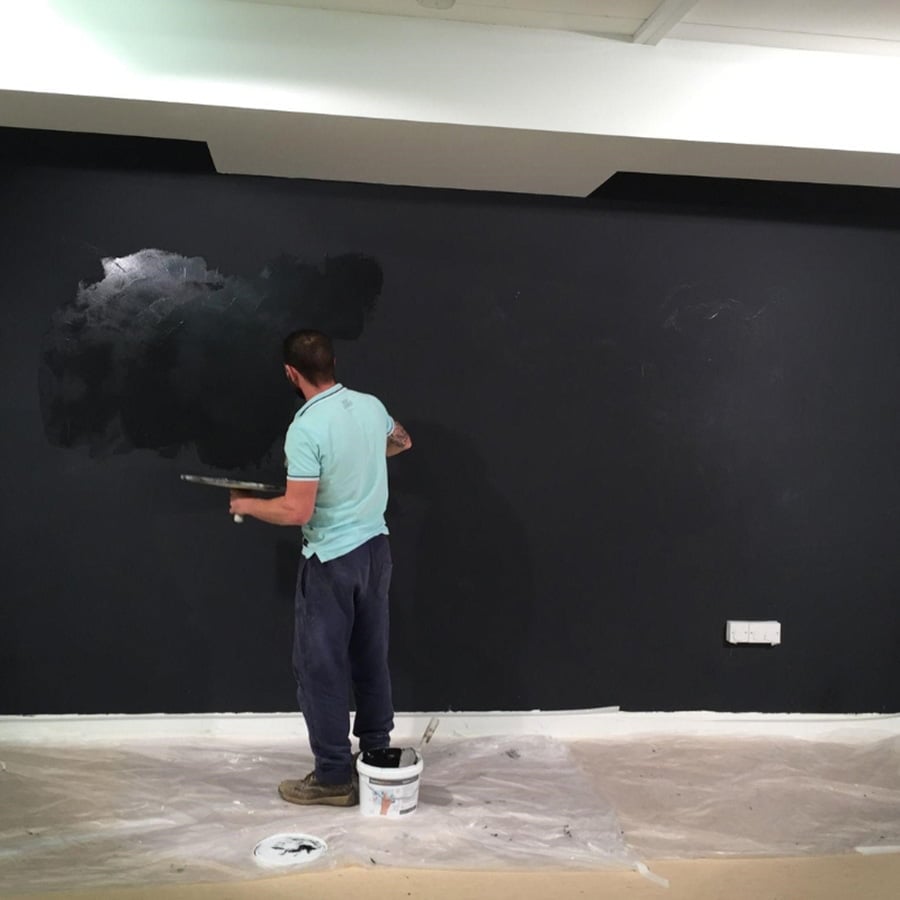
Application: Smarter Surfaces’ team then proceeded with the application of the Ultra High Contrast Projector Screen Paint. This paint was selected for its superior reflective qualities and compatibility with the museum’s various lighting conditions to ensure optimal projection mapping.
Calibration: Following the application, we tested and calibrated the installation. EPIC employees state-of-the-art projectors, and the positioning was fine-tuned to maximise the impact of the images and to ensure the projections were clear, bright, and vibrant from every angle of the room.
Integration: The final step involved integrating the new projection surfaces into the museum’s existing exhibition design. This included adjusting the visual content to fit the unconventional shapes and sizes of the painted walls, ensuring a seamless blend between the projection mapping and the physical environment.
Outcome
The outcome of integrating Smarter Surfaces’ projector paints at EPIC The Irish Emigration Museum was immediate. Visitors to the museum were greeted with the large-scale, high-definition projections that bring the history of Irish emigration to life. The innovative use of Smarter Surfaces technology provided a canvas that is more expansive and interactive for projection mapping when compared to traditional display methods.
The museum’s exhibitions were transformed into a continuous visual journey, without the breaks and limitations of physical screens. This immersive experience allowed the stories, images and data to be presented in a manner that was both educational and engaging. Feedback from visitors was overwhelmingly positive, with many expressing amazement at the seamless integration of visual technology into the historical space.
The flexibility of the projection paint means that EPIC can now update and change their projection mapping without being constrained by the size or shape of digital displays, ensuring that the museum remains at the cutting edge of exhibition design.
Future Spaces
The successful collaboration between EPIC The Irish Emigration Museum and Smarter Surfaces has demonstrated that innovative solutions can be seamlessly integrated into heritage environments. The application of Smarter Surfaces’ projector paints at EPIC has not only enhanced visitor engagement but has done so while preserving the historical essence of the museum’s space.
EPIC’s forward-thinking strategy provides a blueprint for how museums and educational spaces can leverage advanced technologies to their advantage. The versatility of Smarter Surfaces’ projection paints present numerous possibilities for its application. These projection paints can overcome traditional spatial constraints, offering new ways to create interactive and compelling narratives within any environment. Architects and designers now have the tools to build with interactivity in mind, envisioning spaces that are built to actively engage people.
At Smarter Surfaces, we think our partnership with EPIC is a testament to the value that our products can bring to exhibition design. Institutions can present their content in novel ways that engage, educate, and endure in the memories of their audiences. It’s not just limited to the heritage sector. Corporate offices, educational facilities, and even retail spaces can adopt this technology to enhance their environments, making walls and surfaces a dynamic element of their interaction with visitors, customers, and employees.
Get In Touch with Us
The product advisors and industry experts at Smarter Surfaces are ready to answer any question you may have regarding whiteboard paints, magnetic paints, wallpapers, and projection paints.
You can book a free video consultation with us where you show us the wall you want to transform, talk to us about your goals, and we will help you find the most effective products for the purpose.
by sefali | Sep 13, 2023 | Blog

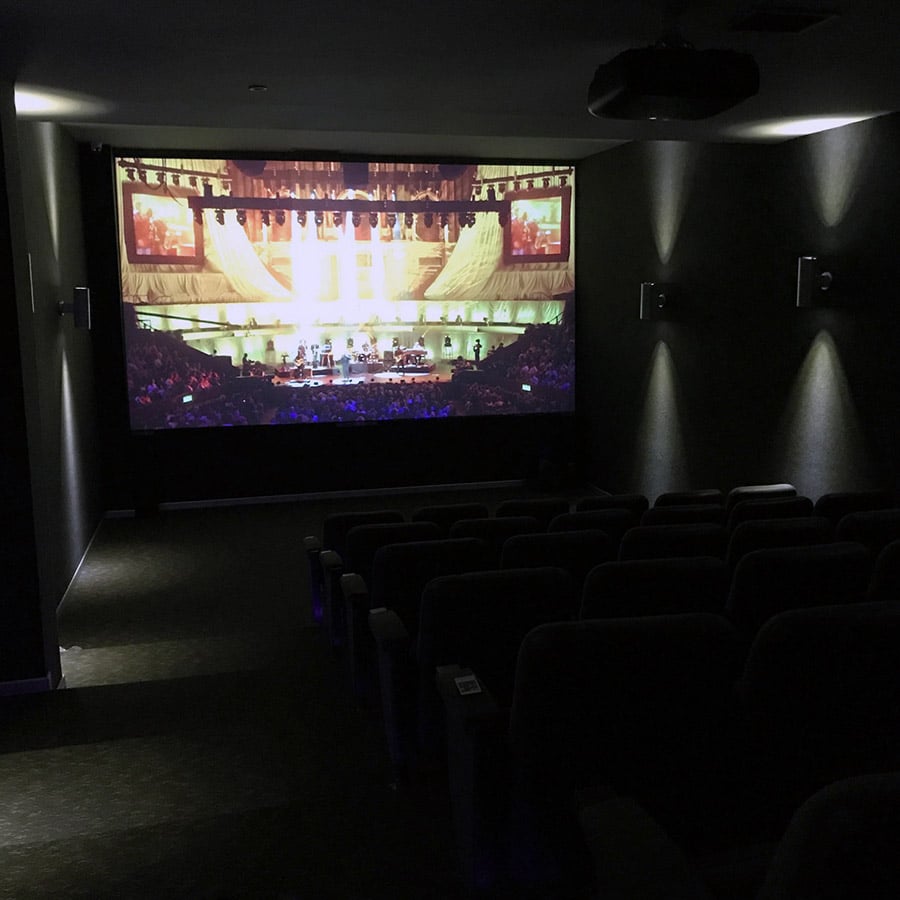
Cinemas and movie theatres have always aimed to provide a captivating and immersive experience for moviegoers. While advanced projection systems and surround sound have enhanced the audiovisual experience, the quality of the projected image itself plays a crucial role.
In recent years, cinema screen paint has emerged as a game-changing solution, allowing cinemas and theatres to transform any suitable surface into a high-performance projection screen.
When choosing a cinema projector screen, gain, contrast, ambient light and surface quality all play a vital role in creating the optimum projection experience. Our projection surface products have been developed to dynamically adjust to these elements with options tailored to the environment you are projecting in.
Smarter Surfaces' Cinema Screen Paint Technology
Our cinema screen paint range was developed with a specialised layering technology to reflect uniform images. This design means they achieve a very smooth finish. This helps ensure pixel clarity, sharpness and uniform brightness, across all the products in the range.
Our projector products have CREST certified performance for application to Surface Finish Quality Standard of EU Level Q4/ US Level 5, guaranteeing a smooth, seamless surface ready for use with a high-quality projector for professional projection results.
Image Quality Optimisation
Image quality optimisation is a key aspect of cinema screen paint that greatly enhances the cinematic experience. These specialised coatings are meticulously formulated to deliver exceptional image fidelity, ensuring that every detail of the movie is faithfully reproduced on the screen.
Colour accuracy is a crucial factor in creating a lifelike and immersive visual experience. Projector paints are engineered to provide excellent colour reproduction, accurately representing the intended hues and shades of the film. Whether it's the vibrant colours of an animated feature or the subtle nuances of a dramatic scene, projector paints ensure that the colours on the screen are vivid, true-to-life, and visually captivating.
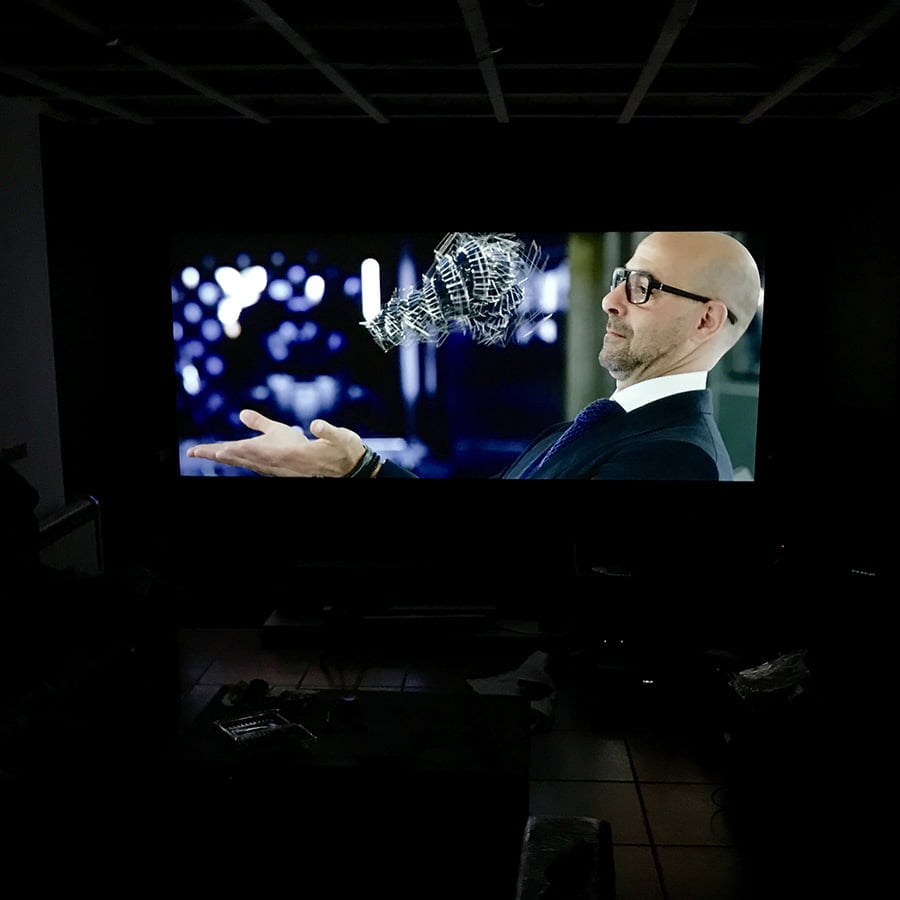
Another critical aspect of image quality is contrast. Smarter Surfaces’ range of cinema screen paints are designed to optimise the contrast ratio, with some paints designed to deliver much higher contrast levels. By minimising light reflection and ambient light interference, our projector paints create a darkened viewing environment, allowing for a more pronounced contrast. This results in scenes with greater depth, detail, and visual impact. Whether it's the shadows creeping in a horror film or the dazzling brightness of a sci-fi spectacle, the optimised contrast offered by projector paints enhances the overall viewing experience.
Brightness is also a vital factor in image quality optimisation. Our cinema screen paint was developed to ensure that the projected image remains bright and vibrant, even in environments with ambient light. By minimising light reflection and hotspots, our paints enable the projection to retain its clarity and visibility, allowing viewers to immerse themselves fully in the on-screen action.
High Contrast Cinema Screen Paint
Grey projector paint screens are specifically designed to increase the contrast levels of the reflected image. By absorbing more ambient light compared to a white screen, these grey screens reduce light reflection and enhance the perceived contrast. This results in deeper blacks, richer colours, and improved overall image quality. However, it's important to note that using a grey projector paint screen will require a higher lumen projector to compensate for the light absorption and ensure vibrant colours are not dulled.
For those seeking even greater contrast and intensified black levels, dark grey and black cinema projector screen paints are available. These specialised coatings further enhance the dark areas of the projected image, resulting in a more immersive and visually striking experience. The intensified black levels create a greater sense of depth and dimension, allowing viewers to fully appreciate the details and nuances in dark and shadowy scenes.
It's worth noting that the choice of projector paint screen colour should be made based on the specific requirements of the projection environment and the desired visual effect. Factors such as ambient light, room size, projector capabilities, and personal preferences should be considered when selecting the appropriate contrast-enhancing screen.
By offering high contrast screens in various shades, projector paint technology provides cinemas and movie theatres with the flexibility to tailor their projection surfaces to optimise image quality and create a captivating cinematic experience for their audiences.
Acoustic Performance of Cinema Screen Paint
Smarter Surfaces cinema screen paints are acoustically transparent and can be used to create acoustically transparent screens. Specifically formulated not to hinder or impact sound transmission through the painted surface, our cinema screen paints necessitate an acoustically transparent substrate or base material for optimal performance.
In the context of an acoustically transparent screen, it is imperative that the paint does not impede the passage of sound waves through the screen, preserving audio quality and facilitating a seamless audiovisual experience. Acoustically transparent paints should not significantly alter the sound absorption characteristics of the base material.
Design Flexibility and Screen Customisation
When it comes to cinemas and movie theatres, one of the standout advantages of projector paints is the flexibility they offer in terms of screen size and shape. Unlike traditional screens that come in fixed dimensions, projector paints can be applied to almost any suitable surface, including walls, ceilings, or even curved surfaces.
This versatility allows cinemas and theatres to adapt their projection area to the available space, maximising seating capacity and optimising the viewing experience for every seat in the house. Additionally, projector paints enable the creation of custom screen sizes, ensuring that the screen perfectly fits the room's dimensions and enhances sightlines for the audience.
Cost-Effectiveness and Scalability
Projector paints offer a cost-effective solution for cinemas and theatres. Compared to traditional screens, projector paints eliminate the need for purchasing expensive screen materials, saving on upfront costs. Additionally, the paints can be reapplied or touched up as needed, extending the lifespan of the projection surface and reducing long-term maintenance expenses. For cinemas with multiple screens or emerging theatres with budget constraints, projector paints provide a scalable option to enhance image quality without significant financial investment.
Installation Simplicity and Maintenance
Installing projector paints is relatively straightforward. The surface needs to be properly prepared, including cleaning, smoothing, and priming, to ensure an optimal projection surface. Once prepared, the paint can be rolled or sprayed onto the surface, allowing for quick and hassle-free application. Projector paints are designed to be durable, capable of withstanding regular cleaning without compromising image quality. However, it is important to note that high-traffic areas may require periodic touch-ups or reapplication to maintain optimal performance.
Considerations for Optimal Performance
To maximise the benefits of projector paints, certain considerations should be taken into account. First, ambient light control is crucial to minimise interference with the projected image. Proper lighting design and the use of light-absorbing materials on walls and ceilings help create a darkened environment for optimal image visibility. Second, the projector itself should be chosen carefully, ensuring compatibility with the projector paint and its specific reflective properties. Lastly, regular calibration of the projection system is recommended to maintain accurate colour reproduction and overall image quality.
Projector paints have revolutionised the cinema and movie theatre industry by offering an innovative, cost-effective, and customisable solution for projection screens. With their ability to optimise image quality, provide design flexibility, and simplify installation and maintenance processes, cinema screen paints have become a valuable tool for enhancing the cinematic experience. Whether it's a blockbuster or an independent film, projector paints play a pivotal role in bringing stories to life on the big screen, captivating audiences and immersing them in a world of imagination.
by sefali | Oct 19, 2020 | Blog
Looking to create a projection surface but overwhelmed with choices? You’re not alone. In this projector screen vs paint showdown, we’ll look at the world of projector options to help you make the best decision.

What Can Projection Paint Be Used For?
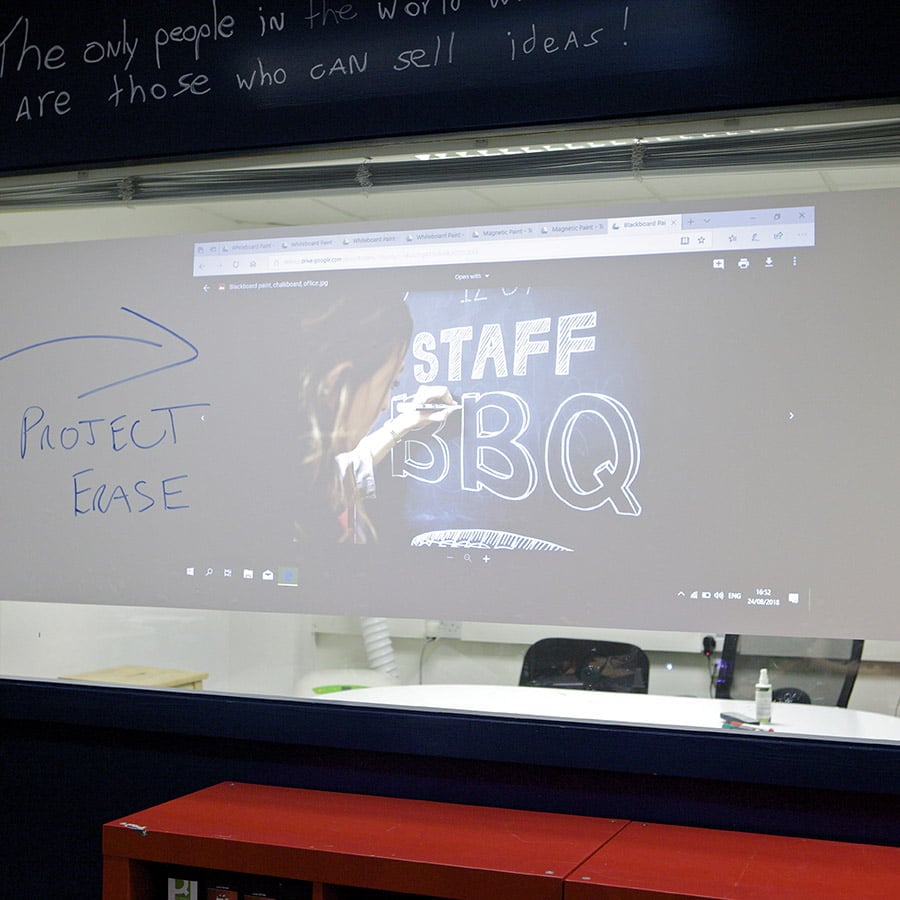
Projection paint is more versatile than you might think. Whether it’s an office, classroom, or your home, projection paint can transform traditional walls into interactive spaces. You can use projector screen paints to turn your office partitions, classroom walls, or even home walls into surfaces perfect for projecting in reduced ambient lighting.
Is It Better to Paint the Wall or Use a Screen for a Projector?
When it comes to projector screen vs paint, the answer may surprise you. While traditional screens have been the go-to choice for years, projection paint offers an innovative and flexible alternative. Using Projector Screen Paint for Offices and Classrooms allows you to customize your projection area size and shape, offering greater flexibility for various room dimensions. This makes it a perfect solution for rooms that have unique configurations or multiple-use purposes, particularly in offices and classrooms.
White Projector Screen Paint Pro offers superior performance with its certified gain value of 1.24, making it ideal for spaces where top-notch projection quality is required.
Can I Use Paint as a Projector Screen?
Absolutely, yes. Products like Ambient Light Rejecting Projector Screen Paint are designed specifically to act as projector screens. They come with benefits like Advanced Ambient Light Rejection, which resists unwanted light, and Enhanced Picture Reproduction, providing luminous, high-definition images. What’s more, you get the ease of paint application to transform any wall into a functional projector screen.
What Are the Differences Between Various Projector Screen Paints?
While regular white paint has a gain value of 1, Smart Projector Screen Paint Pro ups the game with a gain value of 1.1. This difference in gain value means that the Pro version reflects more light, thereby offering a sharper and higher definition projection.
Then there’s Black Projector Screen Paint, designed to absorb ambient light and deliver enhanced image contrast. This is ideal for commercial projection settings or home theaters where powerful, high lumen projectors are in use.
If you prefer a more discreet approach that doesn’t change your room’s aesthetic, Smart Clear Projector Screen Paint is your go-to. This transparent coating optimizes projection performance without altering the existing wall color, making it ideal for those who wish to maintain room design continuity.
Is Projector Screen Paint Worth It?
When weighing the benefits of projector screen vs paint, the value offered by projector screen paint becomes evident. Whether you opt for Outdoor Projector Screen Paint for your garden movie nights or Smart Ultra High Contrast Projector Screen Paint for an enhanced home theatre and gaming experience, the benefits are multifaceted.
For instance, Smart Ultra High Contrast Projector Screen Paint offers deep black levels, high contrast, and is perfect for low ambient lighting conditions. If you’re an enthusiast for visual quality, then it’s worth the investment.
Is a Projector Screen Better Than a White Wall?
A plain white wall may suffice for casual use but will lack the features like enhanced picture reproduction or ambient light rejection that specialized projector screen paint can offer. Products like Short Throw Projector Screen Paint are tested for maximum projection quality and are specifically designed for environments requiring short-throw projectors. This brings us back to the projector screen vs paint debate—why settle for a simple wall when you can optimize your experience?
Outdoor and Specialized Solutions
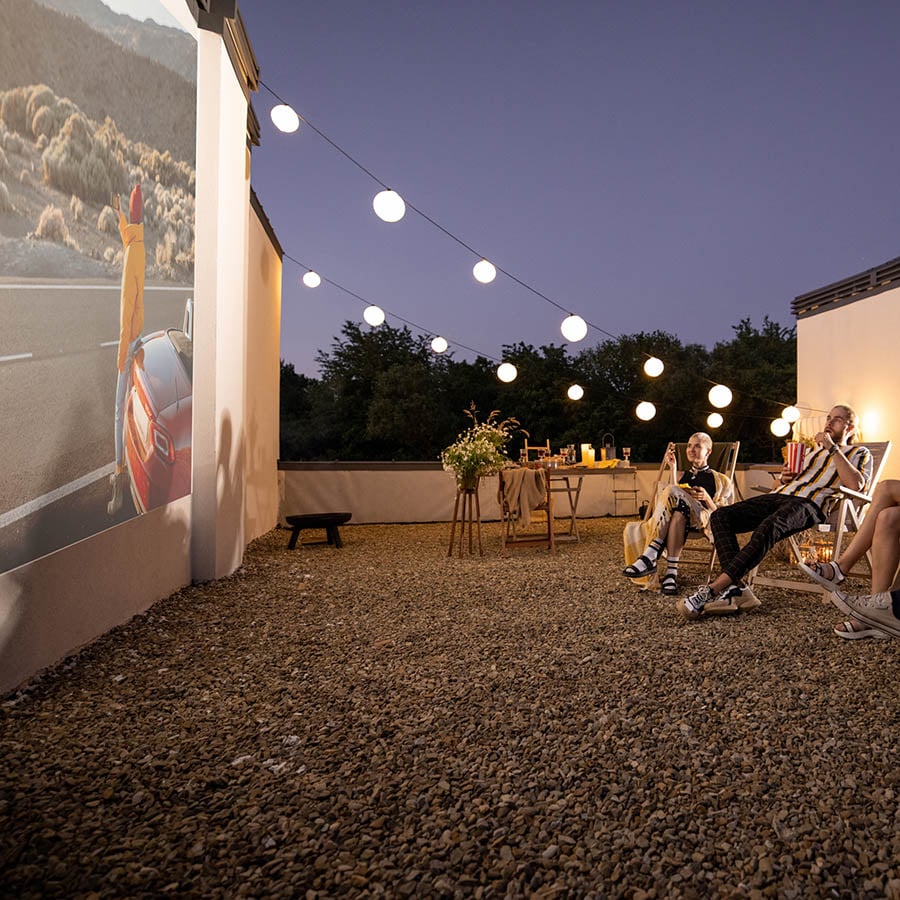
For those interested in outdoor screenings, Smart Outdoor Projector Screen Paint offers weather, UV, and crack resistance, making it suitable for long-lasting outdoor use. When it comes to projector screen vs paint for outdoor use, specialized paint like this provides the flexibility and durability that traditional screens may not offer.
Smart Short Throw Projector Screen Paint is another specialized solution for those using ultra-short-throw projectors. The paint allows for clear pixel resolution up to 4K Ultra HD, making it ideal for professional settings requiring high-definition projections.
Ease of Application
Ease of application is another factor that tilts the scale in favor of projector screen vs paint. Products like Clear Projector Screen Paint come with a simple two-coat system, allowing anyone to transform a wall into a projector screen with minimal effort. This ease of use is found across the range, from Black Projector Screen Paint to Smart Ambient Light Rejecting Paint.
Making the Right Choice in the Projector Screen vs Paint Debate
In terms of performance, products like Smart White Projector Screen Paint Pro offer superior projection performance in varying ambient light settings. When it comes to ease of use and space-saving, projector screen paint outshines traditional screens, allowing you to maintain a sleek and minimalistic room design.
The projector screen vs paint debate comes down to the specifics of your needs and how you envision using your projection surface. If you require a high-performance surface that rejects ambient light and offers superior contrast and depth, going for specialized options like Smart Ambient Light Rejecting Paint or Smart Ultra High Contrast Projector Screen Paint will suit you.
When it comes to looking at a projector screen vs paint, traditional projector screens may offer ease of setup, projector screen paints offer a level of customization, variety, and performance that is hard to match.
by sefali | Oct 19, 2020 | Blog
When you’ve decided to bring the cinematic experience into your home or office, many elements come into play. From the type of projector to the projector screen, every component matters. One aspect that often gets overlooked is the projector screen border. But why is it so crucial, and how can it enhance your viewing experience?

Whether you’re setting up a home theater or enhancing your meeting room, a projector screen border can make a big difference. In this comprehensive guide, we’ll delve into everything you need to know about a projector screen border, including its purpose, types, and ideas for making it visually appealing. We will also touch upon a trendy alternative for projector screens—projector paint—and how you can create a border around it.
Does a Projector Screen Need a Border?
The short answer is no, you don’t absolutely need a projector screen border. In our office, one entire wall serves as a projector wall without any border thanks to our projection wallpaper. That said, a projector screen border offers significant benefits that enhance your viewing experience. It absorbs any light that spills outside of the screen area, helping you in situations where you can’t perfectly align the projected image. Another benefit is the visual enhancement; the contrast between a white screen and a darker border can make images stand out more clearly. This leads us to the question…
Why Do Projector Screens Have a Black Border?
Technically, projector screen borders can be of any color, but black is often preferred due to the Bartleson-Breneman Effect. This phenomenon affects the perceived contrast among areas of different value within an image when the image is viewed against a light or dark background. Simply put, a black projector screen border improves your eye’s ability to process the image by providing a reference point. This, in turn, enhances the image’s contrast, making it appear brighter and more colorful.

If you’re using a specialized paint like Black Projector Screen Paint, your projector screen border can work in conjunction with the enhanced image contrast feature of this paint. The Black Projector Screen Paint absorbs ambient light, thus improving image contrast even further.
The Aesthetics: More Than Just a Frame
At first glance, a projector screen border may seem purely cosmetic, but it serves a higher purpose. It acts as a frame that accentuates the projected image, focusing your attention where it should be: on the screen. Think of it as the frame around a painting; it brings the entire picture into perspective.
Can You Frame a Projector Screen?
Absolutely, framing a projector screen is not only possible but also a popular choice among home theater enthusiasts. A frame around your projector screen border gives it a finished, professional look, almost like a giant cinematic canvas hanging on your wall.
You can choose from a variety of materials like wood or metals for your frame, depending on the aesthetics of the room. The type of border—be it velvet or plastic—also impacts your decision. Velvet surfaces have near-zero reflectivity, while well-made plastic frames minimize reflection.
How to Make Your Projector Screen Look Good: Projector Screen Border Ideas
When it comes to projector screen border ideas, you’re only limited by your creativity. Projector paint is a fantastic alternative to traditional projector screens. It’s a clean, hole-free solution to create a functional wall. To make your projector wall pop, consider using one of the projector paints in our range, and painting a boarder. If you have a high lumen projector you can apply High Contrast Projector Screen Paint or Black Projector Screen Paint and the boarder will be ready to use with the projector screen.
How to Create a Projector Screen Border
Creating your own projector screen can be a rewarding experience. Not only do you get the exact size and finish you desire, but you also have the option to add a customized projector screen border. Below is a step-by-step guide to help you create a projector screen and a black border, enhancing both the aesthetic appeal and the functionality of your DIY screen.
Step 1: Cleaning
All surfaces to be painted should be clean, dry, and free from loose materials.
Step 2: Mark the Dimensions
Measure the area you wish to paint and mark it using masking tape. The maximum dimensions our projector paints will cover is 109.8” x 61.8”. Want a bigger screen? Just add another tin.
Step 3: Priming
Apply two coats of Smart White Primer
Step 4: Sanding
Lightly sand the surface before each coat of primer to ensure a smooth finish.
Step 5: Drying Time
Allow the primer to fully dry (approx. 2-4 hours at 20°) and ensure the surface is smooth.
Step 6: Stir the Projector Paint
Stir the projector paint thoroughly before use.
Step 7: Application
For best results, apply the paint using a mohair or lint-free short pile roller sleeve.
Step 8: Coating
Apply the number of coats depending on the projector paint you’ve purchased, allowing the previous coat to dry before applying the next coat (approx. 2-4 hours at 20°).
Step 9: Mark the Lines for the Border
Once the projector paint is dry, outline your projector screen border with a pencil. Use tape to mark the area. This will define the size and shape of your projector screen border. If you’ve applied High Contrast Projector Screen Paint or Black Projector Screen Paint, your projector screen border is already painted, just reduce the projection size slightly and it will be framed.
Step 10: Choose Your Shape and Color
While a traditional rectangular projector screen border is the go-to option for most, feel free to get creative. You can opt for unique shapes or even incorporate a color that complements your room décor or brand logo. Opt for a black paint that complements your projector screen. A black projector screen border enhances the Bartleson-Breneman Effect, improving your viewing experience.
Step 11: Mask the Border
Tape off the area for the boarder. You will want it to be at least 2 inches to frame it nicely. More on this below.
Step 12: Paint the Border
Use a small roller or brush to carefully paint within the taped-off area. Make sure to apply the paint evenly. Remove the tape while the paint is still wet to avoid peeling off the dried paint.
Step 13: Final Touches
Once the projector screen border is dry, it’s time to test out your new screen. Turn on your projector, align it properly, and enjoy your newly enhanced viewing experience.

The Bartleson-Breneman Effect Explained
The Bartleson-Breneman Effect describes how our eyes perceive contrast in different lighting conditions. Essentially, a black projector screen border creates a “frame of reference,” enhancing your eye’s ability to process the image. This makes the colors appear more vibrant, the blacks deeper, and the whites brighter. If you’re considering installing a projector screen border, understanding this effect can guide your choice of color and material.
Do You Need a Border?
You don’t necessarily need a border for your projector screen or painted wall. However, a border aids in quickly identifying the projection area and can improve the overall visual quality.
Projector Paint vs. Projector Wallcovering
If you’ve opted for a projector wall rather than a traditional projector screen, you might be wondering what to use: projector paint or projector wallcovering. Each has its merits.
Our Projector Wallcoverings, for instance, offer dual and triple functionality: dry-erase and magnetic as well as a projector screen. Our Projector Paints, on the other hand, are a more specialist option, depending on your requirements.
Factors to Consider When Choosing a Projector Screen Border
Now that you understand the importance and benefits of a projector screen border, what should you look for when choosing one? Here are some factors to consider:
Projector Screen Border: Surface Material
When it comes to choosing a material for your projector screen border, you have two prime options: velvet and black projector paint. Velvet border felt is often hailed as the gold standard for its near-zero reflectivity, adding a touch of elegance while effectively absorbing stray light for an immersive viewing experience, but much harder to install.

On the other hand, Black Projector Screen Paint is a cost-effective and flexible alternative that also excels in absorbing ambient light, enhancing image contrast and offering the freedom to create custom border shapes. Both materials have their merits, and the best choice depends on your specific needs, aesthetic preferences, and the projector setup you have in mind.
Projector Screen Border: Width and Depth
The width of the projector screen border typically ranges from 0.5 inches to 3.5 inches. A wider border can make your screen pop and provides a safety net for projector alignment. Depth refers to how far the edge juts out from the screen surface. Deeper borders are aesthetically pleasing and increases the effectiveness of the Bartleson-Breneman Effect.
Projector Screen Border: Shape and Style
Whether you go for a squared or beveled edge, your choice will affect not just the aesthetics but also the maintenance of your projector screen border, as beveled edges collect less dust.
Projector Screen Border: Borderless Screens
While aesthetically appealing, borderless projector screens make perfect alignment almost impossible, leading to light bleed around the edges.
Projector Screen Border: Account for Size
Remember, the size of the projector screen border will add to the overall dimensions of the screen. Make sure to account for this extra size when measuring your available wall space.
What Will Your Choice Be?
A projector screen border serves as more than just a frame for your images; it enhances your viewing experience in numerous ways. Whether you opt for a traditional projector screen or explore projector screen border ideas for a wall painted with projector paint, the options are endless.
So, what will your choice be? A black velvet border to leverage the Bartleson-Breneman Effect, or a black paint. Either way, a well-chosen projector screen border can make all the difference in how you experience your movies, presentations, or video games. We hope this comprehensive guide has given you the insights you need to make an informed decision about your projector screen border. Happy viewing.